
 630-393-3111
4200 Cantera Drive, Suite 200 | Warrenville, IL 60555

-

- Home
- Firm Overview
- Attorneys
- Practice Areas
- Divorce
- Allocation of Parental Responsibility and Decision Making (Child Custody)
- Parenting Time / Visitation
- Spousal Maintenance / Alimony
- Modifications to Child Support and Spousal Maintenance
- Modifications to Allocation of Parental Responsibility, Child Custody and Parenting Time
- Parent & Child Relocation / Removal
- Child Support
- Enforcement of Judgments
- Finances and Divorce
- Businesses and Divorce
- Mediation
- Family Law
- Divorce
- Appeals
- Testimonials
- Blog
- Contact
What Are the Legal Rights of Unmarried Parents?
 If you and your co-parent never married, you may have some questions about your rights and responsibilities. Depending on your situation, you may have to take extra steps to make sure that you have a say in child custody and child support matters. A Naperville, IL family law attorney can advise you in these matters, making sure you have a voice regardless of your marital status.
At Calabrese Associates, P.C., we know just how complicated family law can be for unmarried parents. When you work with our firm, you will receive individual attention and legal advice from our solo practitioner.
Do Unmarried Fathers Have Rights?
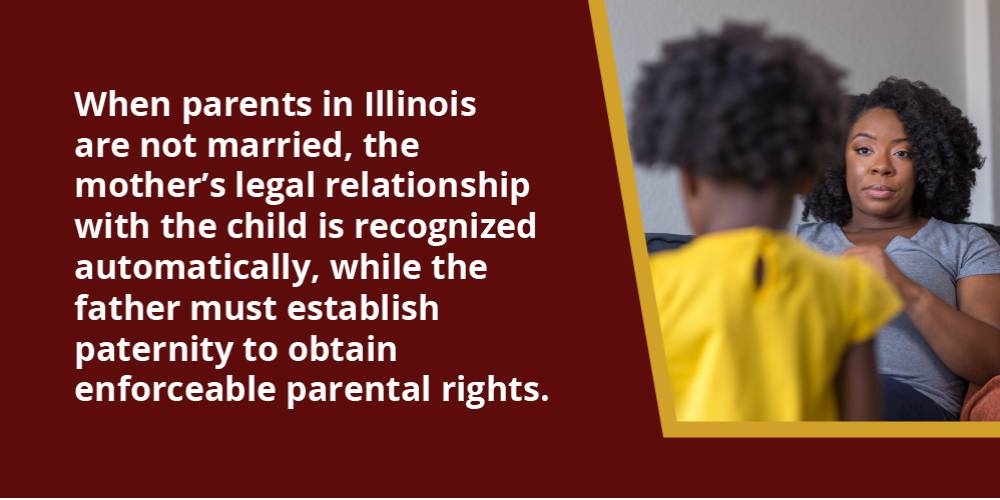
For unmarried mothers, the law generally treats the mother as the child’s legal parent right away. For unmarried fathers, the first step is usually establishing paternity. Once paternity is established, a father can ask the court for parenting time, decision-making responsibilities, and other orders that protect his relationship with his child.
Without paternity, a father may have a much harder time enforcing his role in the child’s life. He might still be involved day to day, but involvement and legal rights are not the same thing. Paternity is often the doorway that allows the court to address custody, parenting time, child support, and related issues in a clear, enforceable way.
What Is a Voluntary Acknowledgment of Paternity?
A Voluntary Acknowledgment of Paternity (often called a VAP) is a form that unmarried parents can sign to legally establish the father-child relationship without going to court. Hospitals often provide it when a child is born, and it may also be completed later through the proper state process.
Signing a VAP is a serious legal step. It is not just paperwork for the birth certificate. It can create a legal finding of paternity, which can affect child support, parenting rights, inheritance, health insurance, and other legal issues.
A VAP is usually appropriate when both parents agree about who the father is and want paternity established quickly. If either parent is unsure, it may be wiser to slow down and get legal advice before signing. Once paternity is established, undoing it can be difficult, and deadlines may apply.
Even when parents sign a VAP, that does not automatically create a full custody schedule. Rather, it merely establishes a legal parent-child relationship.
How Does Child Support Work Between Unmarried Parents?
In Illinois, a mother usually cannot get a child support order against an unmarried father until the legal parent-child relationship is established. In other words, the court needs a legal finding of parentage before it can order child support. Once parentage is established, the court can enter orders for child support and related expenses (750 ILCS 46/802).
Child support represents a parent’s legal duty to help cover a child’s needs. After parentage is established, Illinois usually uses an income shares model for child support. This model factors in each parent’s income and the parenting time schedule. When one parent has most of the parenting time, the other parent may pay support to help cover everyday costs. Even when parenting time is more balanced, support can still be ordered.
Child support orders can also address added costs. These other expenses can include health insurance premiums, uncovered medical bills, and childcare. Informal agreements can fall apart, and they often create problems later. A clear order helps avoid disputes about payment, and it gives both parents a reliable structure to follow.
Can the Court Force a Parent to Take a DNA Test?
If paternity is disputed, the court can order genetic testing. This often comes up when a parent wants support, a father wants parenting time, or someone challenges whether a man is the child’s biological father.
Court-ordered testing is meant to settle the question with reliable evidence. It can protect the child, the mother, and the alleged father by preventing paternity from being decided based on rumors, pressure, or guesswork.
Refusing to cooperate can backfire. A court may draw negative conclusions from a refusal, and it may issue orders to move the case forward. That does not mean the court "guesses" paternity, but it can still create legal consequences when a person does not follow court instructions.
If you are facing a situation where paternity is uncertain, it is important to treat it as a legal issue, not only a personal one. The outcome can shape your parental rights, your financial duties, and your child’s stability for years.
Does Paternity Guarantee Equal Custody Rights in 2026?
Establishing paternity gives an unmarried father the right to ask for custody-related orders. However, it does not guarantee equal parenting time or decision-making. Think of paternity as the foundation. It makes the father a legal parent, which opens the door to custody and parenting time. After that, the court looks at what arrangement serves the child’s best interests.
In Illinois, custody issues are often described in two parts. The first is parenting time, which is the schedule for the time the child spends with each parent. The second part is decision-making responsibilities, which cover major choices in the child's life.
A court may order shared parenting time, a primary schedule with one parent, or another plan that fits the child’s needs. The same is true for decision-making. Some parents share it. Other cases call for one parent to have final decision-making power in certain areas.
Courts look at various factors before making custody decisions. The judge may consider the child’s routines and school life. The court may also look at the child’s home environment, and each parent’s past involvement in the child’s life. These are only a few things the court considers when deciding what is in the child’s best interests.
If you want parenting time or decision-making rights as an unmarried father, you typically need a court order. If you are an unmarried mother and you want clarity and stability, a court order can protect you, too. A formal decree can set expectations, reduce conflict, and give both parents clear rules to follow.
Contact a Naperville, IL Family Law Attorney
Unmarried parenting can become complicated fast. At Calabrese Associates, P.C., we focus on practical solutions that protect children and give parents clear, enforceable court orders. Call 630-393-3111 or contact our Naperville, IL child custody lawyer to schedule a consultation.
 4200 Cantera Drive, Suite 200, Warrenville, IL 60555
 630-393-3111


Contact Our Firm
 The use of the Internet or this form for communication with the firm or any individual member of the firm does not establish an attorney-client relationship. Confidential or time-sensitive information should not be sent through this form.
I have read and understand the Disclaimer and Privacy Policy.

