
 630-393-3111
4200 Cantera Drive, Suite 200 | Warrenville, IL 60555

-

- Home
- Firm Overview
- Attorneys
- Practice Areas
- Divorce
- Allocation of Parental Responsibility and Decision Making (Child Custody)
- Parenting Time / Visitation
- Spousal Maintenance / Alimony
- Modifications to Child Support and Spousal Maintenance
- Modifications to Allocation of Parental Responsibility, Child Custody and Parenting Time
- Parent & Child Relocation / Removal
- Child Support
- Enforcement of Judgments
- Finances and Divorce
- Businesses and Divorce
- Mediation
- Family Law
- Divorce
- Appeals
- Testimonials
- Blog
- Contact
What If My Spouse Refuses to Sign Divorce Papers?
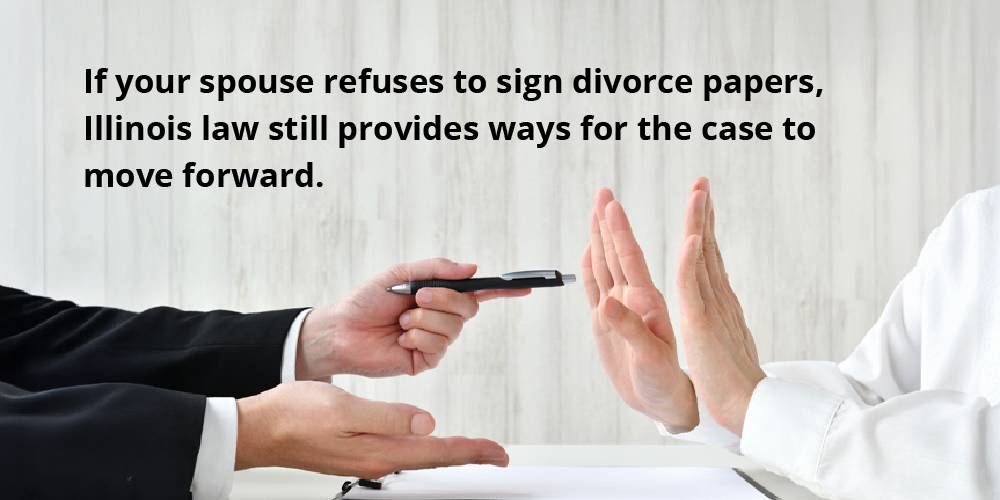
 Filing for divorce often comes with strong emotions from both sides. These feelings are natural and expected. However, if your spouse refuses to sign divorce papers, you may feel as if you’ve reached a dead end. In cases like these, seeking out a lawyer is highly advisable.
At Calabrese Associates, P.C., our DuPage County, IL family law attorney can help you determine your next move. We have experience handling divorces with uncooperative spouses, and we can take action to keep the legal proceedings moving. Attorney Michael Calabrese has over 30 years of legal experience, giving him a rich perspective on contested divorces.
How Do You Serve Divorce Papers in Illinois?
Once you file your divorce petition in Illinois, you must officially notify your spouse. This is called "service of process." It is not enough to simply hand your spouse a copy or text them a photo. The court needs proof that your spouse received the papers in a proper way.
Most people use the sheriff’s office or a private process server. You give them the papers, and they personally deliver the documents to your spouse. Then they sign a form, called a return of service, and file it with the court. This tells the judge that your spouse has been served.
If your spouse is trying to avoid service, you still have options. The process server may try several times, at different times of day. They might try your spouse’s workplace, home, or another known location. If personal service is not possible, your attorney can ask the court to allow alternate service. That might include leaving the papers with someone who lives with your spouse, mailing copies, or even publishing notice in a newspaper, depending on the judge’s order.
What Is a Default Divorce?
After your spouse is served, they have a certain amount of time to respond. In many Illinois divorce cases, that deadline is typically 30 days from the date of service. If your spouse ignores the papers and does nothing, you may be able to ask the court for a "default" divorce.
A default divorce means the judge can move forward even though your spouse has not filed an appearance or an answer. You still have to prove your case. You may need to testify about your marriage, your property, your children, and why the marriage has broken down. You may also need to provide financial documents and propose a parenting plan.
If the judge is satisfied that your spouse was properly served and had a fair chance to participate, the court can enter a divorce judgment without your spouse’s input. This judgment can cover property division, parenting time, decision-making, and support, depending on what you requested.
Your spouse is not completely without rights. In some cases, a spouse who was defaulted can later ask the court to undo the default if they have a strong reason, such as not actually being served. However, this is not guaranteed. Once a default judgment is entered, it can be difficult to change. That is why some spouses eventually decide to participate rather than ignore the case.
Contempt of Court for Uncooperative Spouses
Sometimes, a spouse does not just refuse to sign. They also refuse to follow court orders. For example, a judge may order both spouses to provide pay stubs, bank statements, or tax returns. The uncooperative spouse might ignore these orders, skip hearings, or refuse to follow temporary parenting or support orders.
When this happens, your attorney can ask the court to hold your spouse in contempt. Contempt of court is a serious finding. It means the judge has decided that your spouse knew about the order, had the ability to follow it, and chose not to do so.
When a spouse is found in contempt, the judge has various options for ordering consequences. These can include fines, payment of your attorney’s fees, or even jail time in extreme cases. Often, the mere threat of contempt is enough to push a difficult spouse to start cooperating.
Can You Still Get a Divorce if Your Spouse Doesn’t Want To?
In Illinois, you can still get divorced even if your spouse refuses to sign or says they will never agree. Illinois uses "no fault" divorce based on irreconcilable differences (750 ILCS 5/401). The law does not require both spouses to agree that the marriage is over.
The court mainly wants to know whether the relationship has broken down and whether there is any reasonable chance of saving it. One important part of this is the "living separate and apart" requirement. In most cases, if you and your spouse have lived separate and apart for at least six months, the court will presume that irreconcilable differences exist.
Living separate and apart does not always mean living in different homes. Many couples start living separate lives while still under the same roof. Perhaps you no longer share a bedroom, meals, or finances. You may stop presenting yourselves as a couple in public. The judge can look at the facts and decide whether you have truly separated, even if you still share a house for financial or parenting reasons.
If you have not yet been separated for six months, you can still file for divorce. The court may look at your situation and your testimony about how the marriage has broken down. If both spouses agree, the judge can also waive the six-month period.
Tips for Navigating a Difficult Divorce in 2026
Dealing with a spouse who refuses to sign can be draining. The process may feel slow and frustrating. You may worry about money, your children, and your future. While every case is unique, a few general tips can help you move forward.
First, stay informed. Learn the basic steps of the Illinois divorce process and talk openly with your attorney. When you know what is happening and what comes next, you are less likely to feel powerless. Ask questions until you understand your options.
Second, keep good records. Save texts, emails, and other messages that show your spouse’s refusal to cooperate or their failure to follow orders. Keep copies of financial documents, school records, and medical information. These records can be very helpful if you need to show the court a pattern of behavior.
Lastly, focus on what you can control. You cannot force your spouse to act like an adult, but you can control how you respond. Follow court orders, show up on time, and provide information when asked. Judges notice who is being reasonable and who is causing conflict.
Contact a Naperville, IL Divorce Lawyer
If your spouse refuses to sign divorce papers, you do not have to feel stuck. At Calabrese Associates, P.C., we can explain your options, help you move your case forward, and stand up for your rights at every stage of the process. Call 630-393-3111 or contact our Naperville, IL divorce attorney to discuss your situation and begin planning your next steps.
 4200 Cantera Drive, Suite 200, Warrenville, IL 60555
 630-393-3111


Contact Our Firm
 The use of the Internet or this form for communication with the firm or any individual member of the firm does not establish an attorney-client relationship. Confidential or time-sensitive information should not be sent through this form.
I have read and understand the Disclaimer and Privacy Policy.

